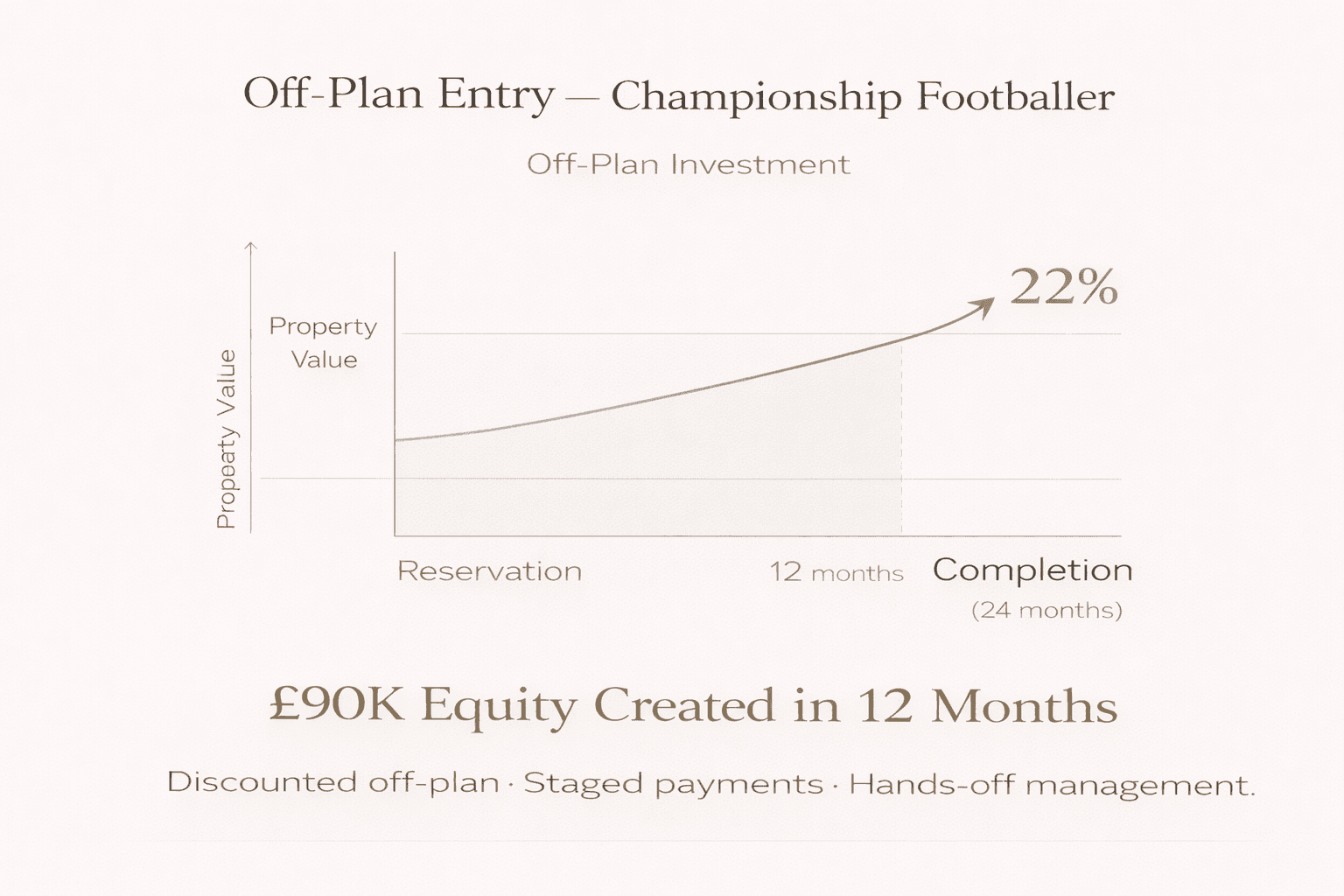
How to Invest in Property as a Professional Footballer: A Practical Guide
How to Invest in Property as a Professional Footballer: A Practical Guide
How to Invest in Property as a Professional Footballer: A Practical Guide
The practical things you need to know if you’re thinking about investing in property as a professional footballer.
The practical things you need to know if you’re thinking about investing in property as a professional footballer.
The practical things you need to know if you’re thinking about investing in property as a professional footballer.
Strategy
Author:
Luther James-Wildin
I’ve played over 300 professional games across League One and League Two.
I’ve played over 300 professional games across League One and League Two.
I’ve played over 300 professional games across League One and League Two.
I’ve seen teammates at every level earn good money and struggle to know what to do with it.
I’ve seen teammates at every level earn good money and struggle to know what to do with it.

I’ve played over 300 professional games across League One and League Two.
I’ve seen teammates at every level earn good money — sometimes serious money — and struggle to know what to do with it.
Not because they weren’t smart. But because nobody in their corner was giving them straight answers about property investment that actually made sense for someone living a footballer’s life.
This is the guide I wish someone had handed me earlier. No jargon. No agenda. Just the practical things you need to know if you’re thinking about investing in property as a professional footballer.
Why Property Makes Sense for Footballers
Your career window is short. Most players get somewhere between 10 and 15 years of earning at their peak, and even then, it’s rarely linear. Contracts end. Clubs change. Injuries happen.
Property gives you something your playing career can’t: an asset that generates income whether you’re playing or not. A buy-to-let property doesn’t care if you’re injured. It doesn’t care if you’re between clubs. It pays rent every month regardless.
Beyond the income, property builds equity over time. You’re not just earning — you’re building a base that will still be working for you long after you’ve hung up your boots.
The Biggest Mistake Footballers Make with Property
Waiting until they’re ready.
I’ve had conversations with players who’ve been meaning to invest in property for years. The money is sitting there. The intention is there. But without a clear strategy, it’s hard to know what’s right — so nothing moves.
One of our clients, Terence, had been in exactly that position. Substantial funds from his contracts. Years of good intentions. But without a framework, it never felt like the right moment. Within 30 days of working together, he’d exchanged on his first off-market property in Manchester.
The lesson isn’t to rush. It’s that clarity is what unlocks action. Get the strategy right first, and the rest follows.
Understanding the Difference Between a Home and an Investment
This sounds obvious, but it catches a lot of players out. When you’re buying a home, you’re buying based on lifestyle. Location near training, a nice area, space for the family. That’s fine — but those criteria are almost never the right criteria for an investment.
An investment property is a business decision. You’re looking at rental yield, tenant demand, capital growth potential, and the fundamentals of the local market. Your feelings about the kitchen don’t come into it.
The best investment areas for a buy-to-let are often not where you’d want to live. Northern cities like Manchester, Leeds, and Birmingham consistently offer stronger yields than London, with growing tenant demand and lower entry prices. That’s where we focus a lot of our sourcing.
Why Off-Market Matters
When most people think about buying an investment property, they go to Rightmove. And there’s nothing wrong with that — but you’re competing with every other buyer in the country for the same publicly listed properties.
Off-market is different. These are properties sold privately through networks and relationships, before they ever reach a portal. Less competition. Often better pricing. And deals that simply aren’t available to anyone without the right connections.
At The Players Property Partners, every deal we source is off-market. That’s not a marketing line — it’s the entire model. Our network of solicitors, agents, and developers means we hear about opportunities that the open market never sees.
What to Do First
Before you look at a single property, get your strategy clear. That means answering three questions:
• What is your goal — income now, capital growth over time, or a mix of both?
• What is your timeline — how long can you leave the capital invested?
• What is your capacity — how much do you want to be involved day-to-day?
Your answers to those questions determine everything: the strategy, the location, the deal type, and the level of management involved. Skip this step and you’re just buying a property. Do it properly and you’re building a portfolio.
That’s exactly what we do in our first call with every client — before we present a single deal.
The Bottom Line
Property investment isn’t complicated. But it does require the right guidance, the right access, and the right timing. If you’ve been thinking about it and haven’t moved yet, the best time to start is now — not when your career ends, and not when you feel perfectly ready.
If you want to understand what’s possible based on where you are right now, request a strategy consultation with us. It’s a short conversation with no pressure — just clarity.
I’ve played over 300 professional games across League One and League Two.
I’ve seen teammates at every level earn good money — sometimes serious money — and struggle to know what to do with it.
Not because they weren’t smart. But because nobody in their corner was giving them straight answers about property investment that actually made sense for someone living a footballer’s life.
This is the guide I wish someone had handed me earlier. No jargon. No agenda. Just the practical things you need to know if you’re thinking about investing in property as a professional footballer.
Why Property Makes Sense for Footballers
Your career window is short. Most players get somewhere between 10 and 15 years of earning at their peak, and even then, it’s rarely linear. Contracts end. Clubs change. Injuries happen.
Property gives you something your playing career can’t: an asset that generates income whether you’re playing or not. A buy-to-let property doesn’t care if you’re injured. It doesn’t care if you’re between clubs. It pays rent every month regardless.
Beyond the income, property builds equity over time. You’re not just earning — you’re building a base that will still be working for you long after you’ve hung up your boots.
The Biggest Mistake Footballers Make with Property
Waiting until they’re ready.
I’ve had conversations with players who’ve been meaning to invest in property for years. The money is sitting there. The intention is there. But without a clear strategy, it’s hard to know what’s right — so nothing moves.
One of our clients, Terence, had been in exactly that position. Substantial funds from his contracts. Years of good intentions. But without a framework, it never felt like the right moment. Within 30 days of working together, he’d exchanged on his first off-market property in Manchester.
The lesson isn’t to rush. It’s that clarity is what unlocks action. Get the strategy right first, and the rest follows.
Understanding the Difference Between a Home and an Investment
This sounds obvious, but it catches a lot of players out. When you’re buying a home, you’re buying based on lifestyle. Location near training, a nice area, space for the family. That’s fine — but those criteria are almost never the right criteria for an investment.
An investment property is a business decision. You’re looking at rental yield, tenant demand, capital growth potential, and the fundamentals of the local market. Your feelings about the kitchen don’t come into it.
The best investment areas for a buy-to-let are often not where you’d want to live. Northern cities like Manchester, Leeds, and Birmingham consistently offer stronger yields than London, with growing tenant demand and lower entry prices. That’s where we focus a lot of our sourcing.
Why Off-Market Matters
When most people think about buying an investment property, they go to Rightmove. And there’s nothing wrong with that — but you’re competing with every other buyer in the country for the same publicly listed properties.
Off-market is different. These are properties sold privately through networks and relationships, before they ever reach a portal. Less competition. Often better pricing. And deals that simply aren’t available to anyone without the right connections.
At The Players Property Partners, every deal we source is off-market. That’s not a marketing line — it’s the entire model. Our network of solicitors, agents, and developers means we hear about opportunities that the open market never sees.
What to Do First
Before you look at a single property, get your strategy clear. That means answering three questions:
• What is your goal — income now, capital growth over time, or a mix of both?
• What is your timeline — how long can you leave the capital invested?
• What is your capacity — how much do you want to be involved day-to-day?
Your answers to those questions determine everything: the strategy, the location, the deal type, and the level of management involved. Skip this step and you’re just buying a property. Do it properly and you’re building a portfolio.
That’s exactly what we do in our first call with every client — before we present a single deal.
The Bottom Line
Property investment isn’t complicated. But it does require the right guidance, the right access, and the right timing. If you’ve been thinking about it and haven’t moved yet, the best time to start is now — not when your career ends, and not when you feel perfectly ready.
If you want to understand what’s possible based on where you are right now, request a strategy consultation with us. It’s a short conversation with no pressure — just clarity.
More insights
More insights


PPP
Not Sure Where to Start?
Book a private consultation to discuss off-market property opportunities tailored for professional athletes and high-net-worth investors.

PPP
Not Sure Where to Start?
Book a private consultation to discuss off-market property opportunities tailored for professional athletes and high-net-worth investors.
PPP
Not Sure Where to Start?
Book a private consultation to discuss off-market property opportunities tailored for professional athletes and high-net-worth investors.
PPP
Not Sure Where to Start?
Book a private consultation to discuss off-market property opportunities tailored for professional athletes and high-net-worth investors.